
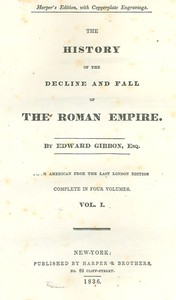
The History of the Decline and Fall of the Roman Empire by Edward Gibbon
Okay, let's be clear: this isn't a novel with a plot. It's a history. But Gibbon gives it a story's momentum. He starts with the Roman Empire at its peak in the 2nd century A.D., a time of peace, good roads, and immense power. Then, he traces the next 1,300 years as that power cracks, fades, and finally shatters. The 'plot' is the empire's long, messy breakup. We see emperors rise and fall, barbarian armies press at the borders, and the old Roman spirit slowly get buried under bureaucracy and new ideas. It ends not with a single event, but with the last remnants of Roman rule in Constantinople falling to the Ottomans in 1453.
Why You Should Read It
Gibbon has a point of view, and that's what makes it brilliant. He's witty, sometimes sarcastic, and always asking 'why.' He argues that Christianity played a big role in softening Rome's military edge, and that internal decay was a bigger threat than any outside army. It’s not dry facts; it's a smart, opinionated conversation with a genius from the 1700s. You’ll find yourself nodding along, then gasping at a shocking anecdote about a crazy emperor, then pausing to think about how his ideas apply even today.
Final Verdict
This is for the patient reader who loves big ideas. It's perfect for history buffs ready for the deep end, or for anyone who enjoys a grand, philosophical argument about why societies fail. Don't try to read all six volumes at once—dip in and out. Think of it as a lifetime companion, a book you return to whenever you need a dose of perspective on the rise and fall of, well, pretty much anything.
The copyright for this book has expired, making it public property. You do not need permission to reproduce this work.
Ashley Anderson
2 years agoI stumbled upon this title during my weekend research and the insights into future trends are particularly thought-provoking. The price-to-value ratio here is simply unbeatable.
Emily Johnson
1 month agoImpressive quality for a digital edition.
Karen Williams
2 years agoThe layout of the digital version made it easy to start immediately, the insights into future trends are particularly thought-provoking. I appreciate the effort that went into this curation.
Patricia Martinez
5 months agoClear, concise, and incredibly informative.


Susan Thomas
11 months agoIt’s rare to find such a well-structured narrative nowadays, the structural organization allows for quick referencing of key points. I feel much more confident in my knowledge after finishing this.